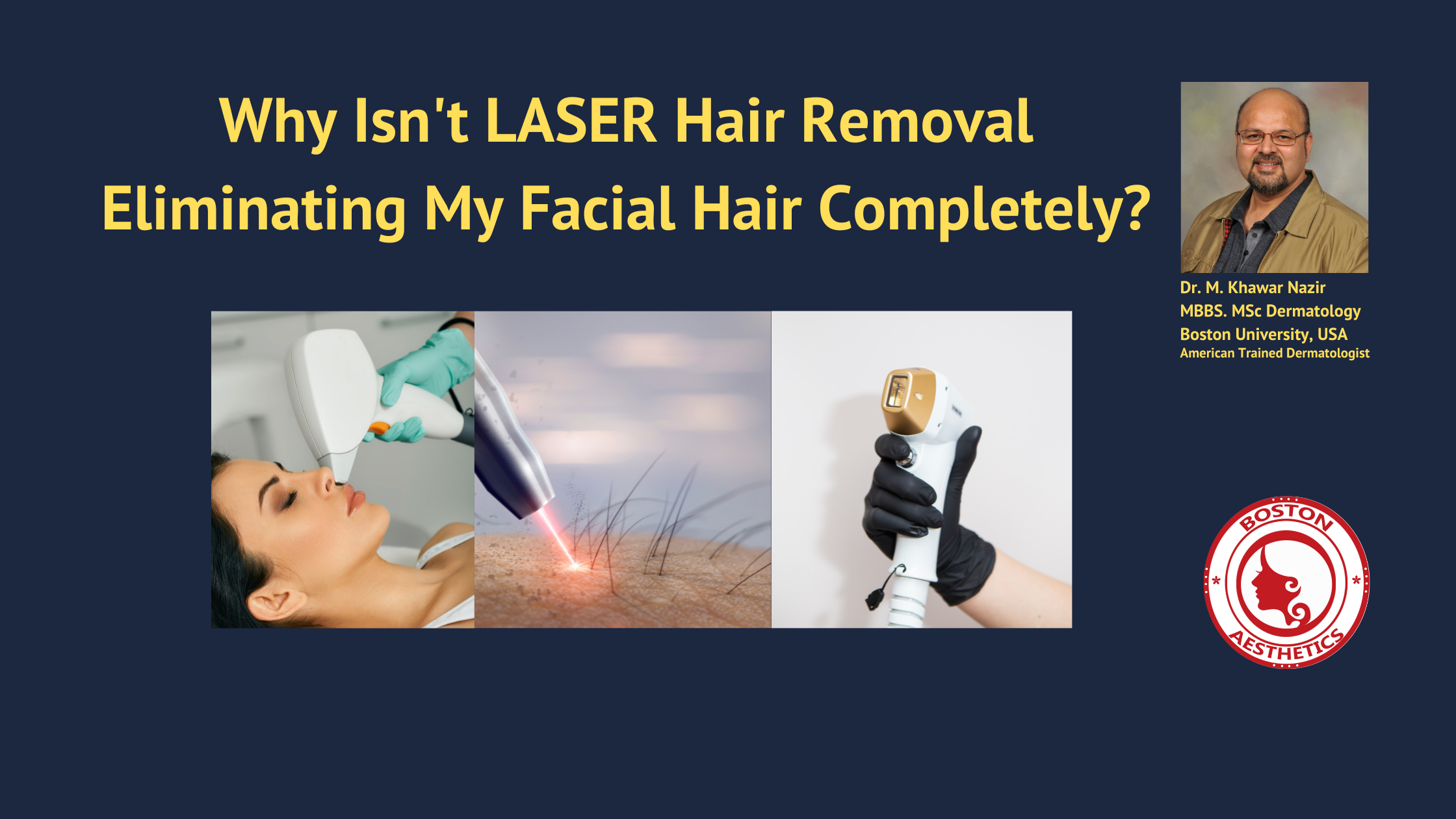
Why Isn’t LASER Hair Removal Eliminating My Facial Hair Completely?
Authored by Dr. M. Khawar Nazir, MBBS, MSc Dermatology, Boston University, USA | American Trained Dermatologist
Introduction
Despite undergoing multiple sessions of LASER hair removal, do you still find yourself struggling with persistent facial hair? You’re not alone. While LASER treatments are effective, they may not always result in complete hair removal. Let’s delve into why this is the case.
Common Queries
Why Isn’t My Facial Hair Going Away?
The efficacy of LASER hair removal depends on various factors, including the type of laser used, your skin tone, hair color, and the skill of the LASER therapist or dermatologist.
Is LASER Hair Removal Permanent?
While it’s effective at reducing hair growth, LASER hair removal often requires maintenance treatments for prolonged results.
Facial LASER Hair Removal: What You Need to Know
Prognosis According to Severity and Duration
LASER hair removal effectiveness can vary. For some, hair re-growth is minimal, while others may require ongoing maintenance treatments.
Importance of Visiting an Endocrinologist
If you’re dealing with persistent or aggravated facial hair, it might be hormonal. An endocrinologist can assess hormonal levels and recommend treatments, if necessary.
Aggravation During and After Treatment
While rare, some individuals report an increase in hair growth, known as “paradoxical hypertrichosis,” post-LASER treatment.
Multiple Factors Contributing to Facial Hair
- Genetics
- Hormonal imbalances
- Certain medications
Stress and Its Effects
Stress can exacerbate hormonal imbalances, which in turn can contribute to facial hair growth and acne aggravation.
Role of PCOS in Facial Hair Growth

Polycystic Ovarian Syndrome (PCOS) can result in hormonal imbalances that lead to facial hair growth. Managing PCOS is often a multi-pronged approach that may include hormonal treatment and LASER hair removal.
Hormonal Imbalances and Facial Hair Growth
Hormonal imbalances are a common underlying factor contributing to unwanted facial hair. Conditions such as Polycystic Ovary Syndrome (PCOS) or thyroid issues can disrupt the natural hormonal balance, leading to increased hair growth. In women, elevated levels of androgens like testosterone can result in facial hair growth, whereas an imbalance in estrogen levels can have similar effects. It is advisable to get a hormonal assessment, possibly involving consultation with an endocrinologist, to identify any underlying issues that need to be addressed alongside LASER treatment.
Managing and Controlling Facial Hair Growth
While professional treatments like LASER hair removal are effective, there are also ways to manage and control facial hair growth at home. For temporary relief, methods like shaving or trimming can be useful. Certain topical creams containing active ingredients like eflornithine can inhibit the enzyme responsible for hair growth, providing a more lasting solution. Moreover, lifestyle changes such as maintaining a balanced diet and regular exercise can also regulate hormonal levels, thereby controlling hair growth.
Final Thoughts
Remember, your body determines how it responds to treatment. The aim of LASER hair removal is not necessarily to ‘cure,’ but to manage and control facial hair growth effectively.
Conclusion
If you’re struggling with ineffective LASER hair removal, don’t lose hope. Consult experts in dermatology and endocrinology for a comprehensive treatment plan. Ready to take the next step? Contact Boston Aesthetics for specialized consultation and treatment options.
For appointments, contact Boston Aesthetics at 15-A, Hali Road, Gulberg II, Lahore, Punjab, Pakistan. Call or WhatsApp at 03334046479.
Ready to Unveil Your Smoothest Skin Yet? Let Boston Aesthetics Be Your Guide!

Leave a Reply